Edward D. Wood Jr.

Edward D. Wood Jr.
(Worst Director of All Time)

Frank Henenlotter

Frank Henenlotter
(Film Maker & Film Historian)
Mostrar mensagens com a etiqueta action-martial arts. Mostrar todas as mensagens

sexta-feira, 20 de abril de 2012

Cyborg


Info About The First Movie Of The Series:

Cyborg is a 1989 American martial-arts science fiction film directed by Albert Pyun. Jean-Claude Van Damme stars as Gibson Rickenbacker, a mercenary who battles a group of murderous marauders led by Fender Tremolo (Vincent Klyn) along the East coast of the United States in a post-apocalyptic future.

Plot

A plague, called the living death, sweeps across a civilization already ruined by “anarchy, genocide and starvation,” a small group of surviving scientists and doctors — located in Atlanta, Georgia, home of the CDC — work on a cure to save what’s left of humanity. To complete their work they need information stored on a computer system in New York City. CDR Pearl Prophet (Dayle Haddon) volunteers for the dangerous courier mission and she is made into a cyborg through surgical augmentation.
Pearl, accompanied by LT Marshall Strat, a man assigned to protect her, retrieves the data in New York, but is pursued by the vicious Fender Tremolo (Vincent Klyn) and his gang of “pirates”. Fender wants the cure so he can have a monopoly on its production. Strat, badly injured in a skirmish with the pirates, tells Pearl to leave him and get to the Bronx township to look for a mercenary, known as a “slinger”, that can escort her to safety. She gets cornered, but is saved by a slinger, Gibson Rickenbacker (Jean-Claude Van Damme), who specializes in getting people out of the city. No sooner does she explain her situation than they are overrun by Fender’s gang and Gibson is knocked out by falling debris. Fender, having beheaded Strat, dangles his head in front of Pearl and tells her that he is going with her to Atlanta. There, she must bring him the cure or else she will “get the horror show.”
Fender's gang slaughter a family and steals their boat. They head south for Atlanta via the Intracoastal Waterway with the captive Pearl. Gibson, who had been tracking the pirates, arrives at the scene of slaughter later that night. A shadowy figure moves to attack him, but he throws a knife that takes the attacker down. She turns out to be Nady Simmons (Deborah Richter), a young woman who’d been hiding since the pirate attack and thought Gibson was one of their gang. After they had time to recover, Nady reveals that her family was wiped out by the plague and that she wants to help Gibson and Pearl. Gibson, meanwhile, is less concerned with a cure for the plague than with finding Fender and eliminating him. Gibson and Nady trek southward through the wastelands, and are ambushed by bandits. He tries to persuade Nady to stay away, saying he does not want to see her die. She tells him she does not want to see him die and offers her body to him, but he refuses: destroying Fender is his only goal.
In flashbacks that haunt Gibson, it is revealed that he had once fallen in love and settled down in an abandoned country house with a client, Mary, and her two young siblings after escorting them from the city. Fender killed Mary and her brother and abducted her sister Haley, forcing Gibson to take up the “slinger” lifestyle once again. Intercepting Fender and his crew near Charleston, South Carolina, Gibson eliminates several of his henchmen in an abandoned warehouse. Gibson manages to get to Fender's guard. As he kills the last one, Fender, watching, opens fire with his own air-rifle. Now nursing a gunshot wound he realizes Haley is now a loyal member of Fender’s crew. He flees and is chased by a dozen of his pirates, Gibson outsmarts them and is alone with Pearl and Nady. Pearl refuses to go with him—she calculates that Gibson is not strong enough to defeat Fender and will be unable to get her to Atlanta safely. She says she will go along with Fender and lure him to his death in Atlanta where she has resources at her disposal. Tired, out of ammunition, wounded and badly outnumbered, Gibson flees with Nady through the sewer—where he ambushes and kills Brick Bardo—and then into a salt marsh where they are pursued by the rest of the pirates and eventually separated from each other in the boggy terrain. Gibson is overpowered, captured, beaten unconscious by Fender and crucified high on the mast of a beached, derelict ship. Haley lingers at the scene, but must leave with Fender. Gibson spends the night on the cross. In the morning, near death, he kicks the mast repeatedly with his dangling feet in a last fit of rage. The mast snaps, sending him crashing to the ground, his arms still nailed to the cross. Finally, Nady appears out of the marsh to free him.
Gibson and Nady intercept Fender once again in Atlanta, and this time are better prepared. The rest of Fender’s gang are taken down one by one until he and Gibson finally meet alone. During their fight, Nady rushes Fender with a knife, but he gashes her with a blade of his own, killing her. Gibson downs Fender with a deep stab wound to the chest. Thinking him dead, Gibson turns around to greet Haley, who is finally free. However, Fender gets back up and they continue to battle in a nearby shed, where Gibson leaves Fender impaled on a large meat hook. Gibson and Haley escort Pearl to her destination, where they leave her and head back "out there".

Production


Cannon Films initially intended to make a sequel to the 1987 He-Man film Masters of the Universe and a live-action version of 'Spider-Man'. Both projects were planned to shoot simultaneously by Albert Pyun. Cannon, however, was in financial trouble and had to cancel deals with both Mattel and Marvel Entertainment, the owners of He-Man and Spider-Man, respectively. Cannon had already spent $2 million on costumes and sets for both films, and decided to start a new project to recoup the money spent on them. Then Pyun wrote the storyline for Cyborg in one weekend. Pyun had Chuck Norris in mind for the lead, but co-producer Menahem Golan cast Jean-Claude Van Damme. The film was shot for less than $500,000 and was filmed in 24 days.[3]
Several of the characters' names are references to well-known manufacturers and models of guitars and other musical instruments.

Jackson "Rock" Pinckney, who played one of Fender's pirates, lost his eye during filming when Jean-Claude Van Damme accidentally struck his eye with a prop knife. Pinckney sued Van Damme in a North Carolina court and was awarded $485,000.[4]
Violent scenes were heavily cut to gain an "R" rating rather than an "X", including a throat-slitting and some blood and gore during the village massacre. Also excised was the death of a man Van Damme was fighting, which caused an inconsistency that made him look like he suddenly disappeared.[5][6]
In the song "Judgment Day" from Method Man's album Tical 2000: Judgement Day, the opening lyrics use most of Fender's opening words to the film. The lyrics are slightly modified. The intro is also in the opening of the song "World Damnation" by the death metal band Mortician. The intro of Fender talking about death and starvation is thought as the official opening of metal band Chimairas' song "Resurrection." It is often played at live shows as an intro.

Reception

Cyborg received a generally negative reception from critics.[7][8][9][10] Review aggregator Rotten Tomatoes reports a 14% positive score, based on 14 reviews, certifying it "Rotten", with an average rating of 2.9/10.[11] However, it retained a cult status.

Sequels

Cyborg 2, starring Elias Koteas and Angelina Jolie, was released in 1993. Cyborg 3: The Recycler, a direct-to-video release, followed in 1995. Both films bear little to no relation to the first film and were heavily panned by critics, even more than the original.

Alternate cut

In early 2011, director Albert Pyun Curnan Pictures got hold of the missing tapes of the original cut of Cyborg through Albert’s original choice for score artist; Tony Riparetti. This director's cut of the film features his editing and some previously-unreleased scenes, and is commercially available through the director himself.[12]

Extracts Taken From: http://en.wikipedia.org/wiki/Cyborg_(film)


O Dragão Ataca (Edição Especial 2 Discos)


Info On This Great Martial Arts Movie:

Enter the Dragon is a 1973 Hong Kong martial arts action film directed by Robert Clouse; starring Bruce Lee, Jim Kelly and John Saxon. This was Bruce Lee's final film appearance before his death on July 20, 1973. Six days after Lee's death, the film was released on July 26, 1973 in Hong Kong.
In 2004, Enter the Dragon was deemed "culturally significant" in the United States and selected for preservation in the National Film Registry.[3]
Enter the Dragon was the first Chinese martial arts film to have been produced by a major Hollywood studio – Warner Bros. and was produced in association with Golden Harvest and Lee's Concord Production Company. The film is largely set in Hong Kong.
Among the stuntmen for the film were members of the Seven Little Fortunes, including Jackie Chan and Sammo Hung. This was arguably instrumental in Chan and Hung's further association with Golden Harvest studios, which later launched their careers. The portly Hung is shown fighting Lee in the opening sequence of the movie and Chan shows up as a henchman when Lee is discovered inside Han's underground lair.
The finished version of the film was significantly different from the original screenplay drafts as Bruce Lee revised much of the script himself, including having written and directed the film's opening Shaolin Monastery fight sequence. Lee wanted to use the film as a vehicle for expressing what he saw as the beauty of his Chinese culture, rather than it being just another action film.

Plot

Lee (Bruce Lee) is a Shaolin martial artist from Hong Kong who possesses great philosophical insight into martial arts as well as physical prowess. He receives an invitation to a martial arts competition on an island organised by the mysterious Han (Shih Kien). Lee learns from his Sifu (teacher) that Han was also once a Shaolin student, but had been expelled from their order for abusing their code of conduct.
A man named Braithwaite (Geoffrey Weeks) from British Intelligence approaches Lee and asks for his help in an undercover mission. Han is suspected to be involved in drug trafficking and prostitution. However, since Han's island is only partly in their jurisdiction, they are unable to conduct any formal investigations - Han will not allow firearms on the island, both to impede assassination attempts and to prevent the international authorities from gaining a justification to launch a raid. Han runs a martial arts school to protect his drug operations, as well as holding his tournament every three years to recruit international talent to expand his criminal business. Before leaving, Lee learns from his teacher that Han's bodyguard O'Hara (Robert Wall) had been involved in the death of his sister, Su Lin (Angela Mao), years ago, when she committed suicide to save herself from dishonour after being cornered by O'Hara and a collection of Han's thugs. During the incident, O'Hara received a facial scar when Lee's father slashed him with a knife.
Lee arrives on Han's island and receives a warm reception. Joining him are other competitors including Roper (John Saxon), a down-on-his-luck white American playboy-gambler on the run from the mob, and Williams (Jim Kelly), an African-American activist on the run after defending himself against two racist white policemen in Los Angeles. Roper and Williams are revealed to be old friends, having served in Vietnam together. They defeat their respective opponents in the competition held the following morning, after arranging for some crooked side-betting on Roper's fight.
That night, the competitors are all offered prostitutes of their choice by Han's assistant, Tania (Ahna Capri). Williams chooses several women, while Roper cunningly chooses Tania (as a mutual attraction is apparent between them). Lee asks for a girl (Betty Chung) whom Braithwaite has placed on the island to gather intelligence, but as she has been kept strictly observed, is unable to gain much information from her. That night, Lee begins searching the island for evidence and finds a secret entrance to an underground base, where drugs are being manufactured and tested on unwitting prisoners. He runs into Han's guards but manages to take them down before they can identify him. He is seen by Williams, who is outside for some fresh air and practice.
The next day, Han warns the competitors about wandering out of their rooms at night. He punishes his guards for failure in their duties and the guards meet their horrible ends at the hands of the sadistic Bolo (Bolo Yeung), Han's chief bodyguard. Moments later, Lee is called to his first match and his opponent turns out to be O'Hara, who is clearly outclassed and eventually attacks Lee with broken bottles. Lee defeats O'Hara and kills his adversary as an act of revenge for his involvement in his sister's suicide. Announcing that O'Hara's dishonourable attack has caused him to lose face very badly, Han ends the day's matches. Later, Han summons Williams and accuses him of attacking the guards the previous night (the 'spy' Lee was with did not mention anything to Han). Williams indignantly denies this, and announces his intention to leave the island; Han brutally beats him to death.
Han takes Roper on a tour of his underground base and invites him to be his representative for his heroin smuggling operations in the United States. When questioned, Han shows Roper the mutilated corpse of Williams, hinting that Roper will face the same fate if he refuses to cooperate. The same night, Lee breaks into the underground base, avoiding a booby trap set for him, and gathers sufficient evidence to warrant Han's arrest, but sets off an alarm while using the radio transmitter to contact Braithwaite. After a spectacular fight with dozens of Han's guards he is eventually lured into a trap and captured.
The next morning, Han asks Roper to fight Lee as a test of his loyalty. Roper refuses and Han sends him to fight Bolo instead. When Roper emerges victorious, the infuriated Han orders his men to kill both Lee and Roper. Despite being hopelessly outnumbered, Lee and Roper manage to hold off the enemy until the captives in Han's underground prison break free and join their side to even the odds. Amidst the chaos, Han attempts to sneak away, only to have Lee follow him. Lee tells Han, "You have offended my family and you have offended the Shaolin Temple." After a spectacular fight in a room full of mirrors, Han is defeated by Lee and impaled on his own spear. When Lee returns to Roper, he finds that most of Han's men have been defeated and rounded up but in a bittersweet moment, Roper also finds Tania's lifeless body lying amongst the wreckage. Lee and Roper exchange a weary thumbs-up just as military helicopters arrive in response to the distress call.

Production

The scene in which Lee states that his style was the style of "Fighting Without Fighting" and then lures Parsons into boarding a dinghy is based upon a famous anecdote involving the 16th century samurai Tsukahara Bokuden.[9][10]
Jackie Chan appears as a guard during the underground lair battle scene and gets his neck snapped by Lee. He also performed several stunts for the film, including the scene where Lee's character quickly climbs a rooftop at night. However Yuen Wah was Lee's main stunt double for the film, most notably for the more acrobatic feats in the film, such as flipping over the abbot's arms at the beginning and the scene where Lee does a backflip when O'Hara catches his leg during their fight.[11]

Reception

In 1973, Enter the Dragon grossed an estimated $25,000,000 in North America,[12] and an estimated $90,000,000 worldwide,[12] on a tight budget of $850,000. In Hong Kong, the film grossed HK$3,307,536[12]—huge business for the time, but substantially less than Lee's Fist of Fury and Way of the Dragon. As of 1999, Enter the Dragon has grossed more than $200,000,000 worldwide.[13]
The film was well received by critics and is regarded by many as one of the best films of 1973.[14][15][16] Critics have referred to Enter the Dragon as "a low-rent James Bond thriller",[17] a "remake of Doctor No" with elements of Fu Manchu.[18] It currently holds a 97% approval rating on the review aggregate website Rotten Tomatoes, with 37 reviews counted and an average rating of 7.8/10.[19] In 2004, the film was deemed "culturally significant" by the Library of Congress and selected for preservation in the National Film Registry.[20]
The film also ranks 474th on Empire magazine's 2008 list of The 500 Greatest Movies of All Time.[21]

Legacy

The film has been parodied and referenced in places such as the satirical publication The Onion,[22] the Japanese game-show Takeshi's Castle, and the comedy films Kentucky Fried Movie and Balls of Fury.
In August 2007, the now defunct Warner Independent Pictures announced that television producer Kurt Sutter would be remaking the film as a noir-style thriller entitled Awaken the Dragon.[23]
The film was considered for two of the American Film Institute's 100 series lists. Lee's character was considered a possible candidate for AFI's 100 Years...100 Heroes and Villains list.[24] The film itself was also a candidate for AFI's 100 Years...100 Thrills, a list of America's most heart-pounding movies.[25]

Extracts Taken From: http://en.wikipedia.org/wiki/Enter_the_Dragon


( http://www.imdb.com/title/tt0070034/ )


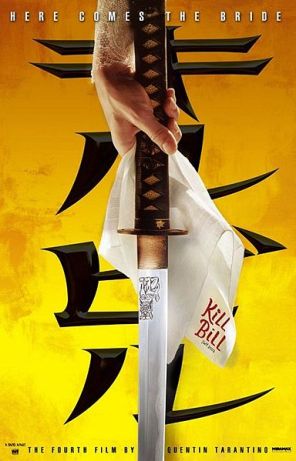
Kill Bill - A Vingança (Volume 1 & 2)


Info About Kill Bill Volume 1:

Kill Bill: Volume 1 is a 2003 American action/thriller film written and directed by Quentin Tarantino. It is the first of two films that were theatrically released several months apart, the second one titled Kill Bill Volume 2.
Kill Bill was originally scheduled for a single theatrical release, but with a running time of over four hours, it was separated into two volumes. Kill Bill: Volume 1 was released in late 2003, and Kill Bill: Volume 2 was released in early 2004. The two films are frequently referred to collectively as simply "Kill Bill."
They follow a character initially identified as "The Bride", a former member of an assassination team who seeks revenge on her ex-colleagues who massacred members of her wedding party and tried to kill her. The movie is often noted for its stylish direction and its homages to film genres such as Hong Kong martial arts films, Japanese chanbara films, Italian spaghetti westerns, girls with guns, and rape and revenge; resultingly, Kill Bill has gained a cult-movie status with action movie aficionados worldwide.

Plot

The film opens with an intertitle displaying the proverb "Revenge is a dish best served cold" (though the quote is credited as being an "Old Klingon Proverb", as it was in Star Trek II: The Wrath of Khan). A pregnant Beatrix Kiddo (Uma Thurman), known as "The Bride", lies badly wounded at her wedding, telling an unseen Bill (David Carradine) that she is carrying his baby, as he shoots her in the head. We later learn that she miraculously survived the head shot but was left comatose for four years.
Out of sequence, the film shows Kiddo's second revenge killing following her recovery. Kiddo finds Vernita Green (Vivica A. Fox) at her home and fights her, but they cease after Vernita's young daughter Nikki arrives from school. It is revealed that both women are former members of the Deadly Viper Assassination Squad, elite assassins under the employ of Bill. Bill had ordered the attack on Kiddo in revenge for her decision to leave Bill and secretly marry. While the two women are talking in the kitchen during their truce, Vernita attempts to kill Kiddo with a revolver hidden in a box of "Kaboom" cereal. The shot misses Kiddo, who retaliates with a throwing knife to Vernita's chest, and she dies slowly. When Kiddo notices Nikki standing in the doorway, she offers Nikki revenge should she seek it as an adult, then leaves. Kiddo then strikes Vernita's name off a checklist; the name "O-Ren Ishii" has already been crossed out.
Going back to the time of her coma, another member of the Deadly Vipers, the one-eyed Elle Driver (Daryl Hannah), enters Kiddo's hospital room where she lies comatose, and prepares a lethal injection but is interrupted by Bill on the phone, who states they will take action only if she wakes. Four years later, Kiddo awakens and is horrified to discover that she is no longer pregnant, leading her to assume that her baby is dead. Meanwhile, she learns that a hospital worker named Buck has been raping her in her comatose state, and accepting cash from those who wish the chance to do the same. While a trucker is preparing to assault her, Kiddo bites off his tongue and kills him. She then incapacitates and kills Buck by repeatedly smashing his head between a door and its jamb, and steals Buck's truck. She swears revenge, and picks her first target: O-Ren Ishii (Lucy Liu), who has since become the leader of the Tokyo yakuza.
Once she recovers, Kiddo travels to Okinawa to obtain a sword from legendary swordsmith Hattori Hanzō (Sonny Chiba), who has sworn never to forge a sword again. After learning that her target is his former student, Bill, he agrees he is morally obligated to forge his finest sword for her. Kiddo tracks down O-Ren at a Tokyo nightclub, challenging her to a fight and severing the arm of Sofie Fatale (Julie Dreyfus), O-Ren's assistant and a protégée of Bill's. She then fights off O-Ren's Yakuza army, including the elite "Crazy 88" squad and O-Ren's personal bodyguard, 17-year-old sadist Gogo Yubari (Chiaki Kuriyama), before dueling O-Ren in a snow-draped Japanese garden and killing her. She finally tortures Sofie into revealing information about Bill, leaving Sofie alive to tell Bill that Kiddo is coming to kill him and the others. The film ends with Bill asking Sofie if Kiddo knows that her daughter is still alive.

Influences

The overall storyline of Kill Bill is adapted from Lady Snowblood, a 1973 Japanese film in which a woman kills off the gang who murdered her family. The Guardian commented that Lady Snowblood was "practically a template for the whole of Kill Bill Vol. 1".[2] Lady Snowblood was adapted from the manga of the same name written by Kazuo Koike and illustrated by Kazuo Kamimura.
It references the TV show Yagyû ichizoku no inbô (Japanese > "Intrigue of the Yagyu Clan") by quoting a variant of the speech in the show's opening sequence.
Jubei Yagyu (Sonny Chiba) [The Yagyu Conspiracy]: "The Secret Doctrine of Ura Yagyu ("Hidden Yagyu") states: 'Once engaged in battle, fight to win. That is the first and cardinal rule of battle. Suppress all human emotions and compassion. Kill whosoever stands in thy way, even if that be a God or Buddha. Only then can one master the essence of the art. Once it is mastered, thou shall fear no one, though even devils block thy way.'"
Hattori Hanzo XV (Sonny Chiba) [Kill Bill]: "For those regarded as warriors, when engaged in combat the vanquishing of thine enemy can be the warrior's only concern. Suppress all human emotion and compassion. Kill whoever stands in thy way, even if that be Lord God or Buddha himself. This truth lies at the heart of the art of combat."
The film also references Samurai Reincarnation (1981) by quoting its iconic line: "If you encounter God, God will be cut". Hattori Hanzō is modelled on legendary sword maker Muramasa. The character is also a reference to the Japanese television show Kage no Gundan (Shadow Warriors in America), in which Sonny Chiba portrayed a fictionalized version of Hattori Hanzō, as well as his descendants in later seasons. Tarantino, in Vol. 1 special features, claims that his film's Hanzō is one of those descendants.
Kill Bill pays tribute to film genres including the spaghetti western, blaxploitation, Chinese wuxia, Japanese yakuza films, Japanese samurai cinema, and kung fu movies of the 1960s and 1970s. This last genre, which was largely produced by the Shaw Brothers, is given an obvious nod by the inclusion of the Shaw Scope logo at the beginning of Kill Bill Vol. 1.
One influential exploitation film that Tarantino has mentioned in interviews is the Swedish Thriller - en grym film, released in the U.S. as They Call Her One Eye. Tarantino, who has called Thriller "the roughest revenge movie ever made',[3] recommended that actress Daryl Hannah watch the film to prepare for her role as the one-eyed killer Elle Driver.[4]

Extracts Taken From: http://en.wikipedia.org/wiki/Kill_Bill_Volume_1


Info About Kill Bill Volume 2:

Kill Bill: Volume 2 is a 2004 American action/thriller film written and directed by Quentin Tarantino. It is the second of two volumes that were theatrically released several months apart. Kill Bill was originally scheduled for a single theatrical release, but with a running time of over four hours, it was separated into two volumes. Kill Bill Volume 1 was released in late 2003, and Kill Bill: Volume 2 was released in early 2004. The volumes follow a character initially identified as "The Bride", a former member of an assassination team who seeks revenge on her ex-colleagues who massacred members of her wedding party and tried to kill her. The film is often noted for its stylish direction and its homages to film genres such as Hong Kong martial arts films, Japanese chanbara films, Italian spaghetti westerns, girls with guns, and rape and revenge.[citation needed]

Plot

In a flashback, Beatrix Kiddo (Uma Thurman) — the visibly pregnant Bride — and her groom (Chris Nelson) rehearse their wedding. Bill (David Carradine), her former lover and the leader of the Deadly Viper Assassination Squad, arrives unexpectedly and wishes her well, and it is revealed that Kiddo had retired from assassination and left Bill in order to give a better life to her unborn daughter. Moments later, the other assassination squad members arrive and attack the wedding rehearsal on Bill's orders.
In the present, Bill warns his brother Budd (Michael Madsen), a former Deadly Viper and now a bouncer, that he will be targeted next. Kiddo arrives at his trailer and bursts through the door, expecting to ambush him, but Budd is expecting her, shooting her in the chest with a double-barreled shotgun blast of rock salt, then sedates her. Budd calls Elle Driver (Daryl Hannah), another former Deadly Viper, offering to sell her Kiddo's Hanzō sword for a million dollars cash. He then seals Kiddo inside a coffin and buries her alive.
A flashback shows Bill taking Kiddo to be trained by legendary martial arts master Pai Mei (Gordon Liu). She eventually gains his respect and learns a number of techniques, including the art of punching through thick planks of wood from inches away, and a technique, taught to nobody else, of killing using apparently non-lethal touches to pressure points. She uses the former skill to break out of the coffin and claws her way to the surface.
Elle arrives at Budd's trailer for their transaction but has hidden a lethal black mamba with her money, which kills him. She then tells Bill (by phone) that Kiddo has killed Budd by putting a black mamba (the deadly viper that was Kiddo's assassination squad code name) in his trailer, and that Elle has killed Kiddo. As she exits the trailer, she is ambushed by Kiddo, who had arrived there soon after Elle. In the middle of an all-out battle in the trailer, Elle taunts Kiddo with the news that Elle had poisoned Pai Mei in revenge for his snatching out her eye when she called him a 'miserable old fool'. Kiddo then plucks out Elle's remaining eye and leaves her screaming and thrashing about in the trailer with the black mamba.
Kiddo travels to Mexico to query an elderly gentlemen about Bill's whereabouts. The man, who is the proprietor of a brothel, was purportedly a father figure to a younger Bill. Regardless, the man divulges Bill's location.
After finding Bill deep in the Mexican countryside, Kiddo is shocked to find her now-four-year-old daughter B.B. (Perla Haney-Jardine) alive and well. She spends the evening with Bill and B.B. After B.B. has gone to bed, Bill shoots Kiddo with a dart containing a truth serum and interrogates her. A flashback recalls Kiddo's discovery of her pregnancy while on an assassination mission, and her resulting decision to call off her assignment and leave the Deadly Vipers. Kiddo explains that she ran away without telling Bill in order to protect their unborn daughter from him and his life. Though Bill understands, he remains unapologetic for what he did, explaining that he's a murdering bastard and there are consequences to breaking the heart of a murdering bastard. They fight, but although Kiddo loses her weapon, she disables Bill with Pai Mei's fatal pressure point technique, which he secretly taught her. Bill, aware of the technique and that he will shortly die, makes his peace with Kiddo and dies. Kiddo departs with B.B.; later they are seen watching cartoons in a hotel together after Beatrix gives thanks.

Extract Taken From: http://en.wikipedia.org/wiki/Kill_Bill_Volume_2


( http://www.imdb.com/title/tt0266697/ )

( http://www.imdb.com/title/tt0378194/ )