Edward D. Wood Jr.

Edward D. Wood Jr.
(Worst Director of All Time)

Frank Henenlotter

Frank Henenlotter
(Film Maker & Film Historian)
Mostrar mensagens com a etiqueta miramax films_. Mostrar todas as mensagens

sexta-feira, 20 de abril de 2012

Kill Bill - A Vingança (Volume 1 & 2)


Info About Kill Bill Volume 1:

Kill Bill: Volume 1 is a 2003 American action/thriller film written and directed by Quentin Tarantino. It is the first of two films that were theatrically released several months apart, the second one titled Kill Bill Volume 2.
Kill Bill was originally scheduled for a single theatrical release, but with a running time of over four hours, it was separated into two volumes. Kill Bill: Volume 1 was released in late 2003, and Kill Bill: Volume 2 was released in early 2004. The two films are frequently referred to collectively as simply "Kill Bill."
They follow a character initially identified as "The Bride", a former member of an assassination team who seeks revenge on her ex-colleagues who massacred members of her wedding party and tried to kill her. The movie is often noted for its stylish direction and its homages to film genres such as Hong Kong martial arts films, Japanese chanbara films, Italian spaghetti westerns, girls with guns, and rape and revenge; resultingly, Kill Bill has gained a cult-movie status with action movie aficionados worldwide.

Plot

The film opens with an intertitle displaying the proverb "Revenge is a dish best served cold" (though the quote is credited as being an "Old Klingon Proverb", as it was in Star Trek II: The Wrath of Khan). A pregnant Beatrix Kiddo (Uma Thurman), known as "The Bride", lies badly wounded at her wedding, telling an unseen Bill (David Carradine) that she is carrying his baby, as he shoots her in the head. We later learn that she miraculously survived the head shot but was left comatose for four years.
Out of sequence, the film shows Kiddo's second revenge killing following her recovery. Kiddo finds Vernita Green (Vivica A. Fox) at her home and fights her, but they cease after Vernita's young daughter Nikki arrives from school. It is revealed that both women are former members of the Deadly Viper Assassination Squad, elite assassins under the employ of Bill. Bill had ordered the attack on Kiddo in revenge for her decision to leave Bill and secretly marry. While the two women are talking in the kitchen during their truce, Vernita attempts to kill Kiddo with a revolver hidden in a box of "Kaboom" cereal. The shot misses Kiddo, who retaliates with a throwing knife to Vernita's chest, and she dies slowly. When Kiddo notices Nikki standing in the doorway, she offers Nikki revenge should she seek it as an adult, then leaves. Kiddo then strikes Vernita's name off a checklist; the name "O-Ren Ishii" has already been crossed out.
Going back to the time of her coma, another member of the Deadly Vipers, the one-eyed Elle Driver (Daryl Hannah), enters Kiddo's hospital room where she lies comatose, and prepares a lethal injection but is interrupted by Bill on the phone, who states they will take action only if she wakes. Four years later, Kiddo awakens and is horrified to discover that she is no longer pregnant, leading her to assume that her baby is dead. Meanwhile, she learns that a hospital worker named Buck has been raping her in her comatose state, and accepting cash from those who wish the chance to do the same. While a trucker is preparing to assault her, Kiddo bites off his tongue and kills him. She then incapacitates and kills Buck by repeatedly smashing his head between a door and its jamb, and steals Buck's truck. She swears revenge, and picks her first target: O-Ren Ishii (Lucy Liu), who has since become the leader of the Tokyo yakuza.
Once she recovers, Kiddo travels to Okinawa to obtain a sword from legendary swordsmith Hattori Hanzō (Sonny Chiba), who has sworn never to forge a sword again. After learning that her target is his former student, Bill, he agrees he is morally obligated to forge his finest sword for her. Kiddo tracks down O-Ren at a Tokyo nightclub, challenging her to a fight and severing the arm of Sofie Fatale (Julie Dreyfus), O-Ren's assistant and a protégée of Bill's. She then fights off O-Ren's Yakuza army, including the elite "Crazy 88" squad and O-Ren's personal bodyguard, 17-year-old sadist Gogo Yubari (Chiaki Kuriyama), before dueling O-Ren in a snow-draped Japanese garden and killing her. She finally tortures Sofie into revealing information about Bill, leaving Sofie alive to tell Bill that Kiddo is coming to kill him and the others. The film ends with Bill asking Sofie if Kiddo knows that her daughter is still alive.

Influences

The overall storyline of Kill Bill is adapted from Lady Snowblood, a 1973 Japanese film in which a woman kills off the gang who murdered her family. The Guardian commented that Lady Snowblood was "practically a template for the whole of Kill Bill Vol. 1".[2] Lady Snowblood was adapted from the manga of the same name written by Kazuo Koike and illustrated by Kazuo Kamimura.
It references the TV show Yagyû ichizoku no inbô (Japanese > "Intrigue of the Yagyu Clan") by quoting a variant of the speech in the show's opening sequence.
Jubei Yagyu (Sonny Chiba) [The Yagyu Conspiracy]: "The Secret Doctrine of Ura Yagyu ("Hidden Yagyu") states: 'Once engaged in battle, fight to win. That is the first and cardinal rule of battle. Suppress all human emotions and compassion. Kill whosoever stands in thy way, even if that be a God or Buddha. Only then can one master the essence of the art. Once it is mastered, thou shall fear no one, though even devils block thy way.'"
Hattori Hanzo XV (Sonny Chiba) [Kill Bill]: "For those regarded as warriors, when engaged in combat the vanquishing of thine enemy can be the warrior's only concern. Suppress all human emotion and compassion. Kill whoever stands in thy way, even if that be Lord God or Buddha himself. This truth lies at the heart of the art of combat."
The film also references Samurai Reincarnation (1981) by quoting its iconic line: "If you encounter God, God will be cut". Hattori Hanzō is modelled on legendary sword maker Muramasa. The character is also a reference to the Japanese television show Kage no Gundan (Shadow Warriors in America), in which Sonny Chiba portrayed a fictionalized version of Hattori Hanzō, as well as his descendants in later seasons. Tarantino, in Vol. 1 special features, claims that his film's Hanzō is one of those descendants.
Kill Bill pays tribute to film genres including the spaghetti western, blaxploitation, Chinese wuxia, Japanese yakuza films, Japanese samurai cinema, and kung fu movies of the 1960s and 1970s. This last genre, which was largely produced by the Shaw Brothers, is given an obvious nod by the inclusion of the Shaw Scope logo at the beginning of Kill Bill Vol. 1.
One influential exploitation film that Tarantino has mentioned in interviews is the Swedish Thriller - en grym film, released in the U.S. as They Call Her One Eye. Tarantino, who has called Thriller "the roughest revenge movie ever made',[3] recommended that actress Daryl Hannah watch the film to prepare for her role as the one-eyed killer Elle Driver.[4]

Extracts Taken From: http://en.wikipedia.org/wiki/Kill_Bill_Volume_1


Info About Kill Bill Volume 2:

Kill Bill: Volume 2 is a 2004 American action/thriller film written and directed by Quentin Tarantino. It is the second of two volumes that were theatrically released several months apart. Kill Bill was originally scheduled for a single theatrical release, but with a running time of over four hours, it was separated into two volumes. Kill Bill Volume 1 was released in late 2003, and Kill Bill: Volume 2 was released in early 2004. The volumes follow a character initially identified as "The Bride", a former member of an assassination team who seeks revenge on her ex-colleagues who massacred members of her wedding party and tried to kill her. The film is often noted for its stylish direction and its homages to film genres such as Hong Kong martial arts films, Japanese chanbara films, Italian spaghetti westerns, girls with guns, and rape and revenge.[citation needed]

Plot

In a flashback, Beatrix Kiddo (Uma Thurman) — the visibly pregnant Bride — and her groom (Chris Nelson) rehearse their wedding. Bill (David Carradine), her former lover and the leader of the Deadly Viper Assassination Squad, arrives unexpectedly and wishes her well, and it is revealed that Kiddo had retired from assassination and left Bill in order to give a better life to her unborn daughter. Moments later, the other assassination squad members arrive and attack the wedding rehearsal on Bill's orders.
In the present, Bill warns his brother Budd (Michael Madsen), a former Deadly Viper and now a bouncer, that he will be targeted next. Kiddo arrives at his trailer and bursts through the door, expecting to ambush him, but Budd is expecting her, shooting her in the chest with a double-barreled shotgun blast of rock salt, then sedates her. Budd calls Elle Driver (Daryl Hannah), another former Deadly Viper, offering to sell her Kiddo's Hanzō sword for a million dollars cash. He then seals Kiddo inside a coffin and buries her alive.
A flashback shows Bill taking Kiddo to be trained by legendary martial arts master Pai Mei (Gordon Liu). She eventually gains his respect and learns a number of techniques, including the art of punching through thick planks of wood from inches away, and a technique, taught to nobody else, of killing using apparently non-lethal touches to pressure points. She uses the former skill to break out of the coffin and claws her way to the surface.
Elle arrives at Budd's trailer for their transaction but has hidden a lethal black mamba with her money, which kills him. She then tells Bill (by phone) that Kiddo has killed Budd by putting a black mamba (the deadly viper that was Kiddo's assassination squad code name) in his trailer, and that Elle has killed Kiddo. As she exits the trailer, she is ambushed by Kiddo, who had arrived there soon after Elle. In the middle of an all-out battle in the trailer, Elle taunts Kiddo with the news that Elle had poisoned Pai Mei in revenge for his snatching out her eye when she called him a 'miserable old fool'. Kiddo then plucks out Elle's remaining eye and leaves her screaming and thrashing about in the trailer with the black mamba.
Kiddo travels to Mexico to query an elderly gentlemen about Bill's whereabouts. The man, who is the proprietor of a brothel, was purportedly a father figure to a younger Bill. Regardless, the man divulges Bill's location.
After finding Bill deep in the Mexican countryside, Kiddo is shocked to find her now-four-year-old daughter B.B. (Perla Haney-Jardine) alive and well. She spends the evening with Bill and B.B. After B.B. has gone to bed, Bill shoots Kiddo with a dart containing a truth serum and interrogates her. A flashback recalls Kiddo's discovery of her pregnancy while on an assassination mission, and her resulting decision to call off her assignment and leave the Deadly Vipers. Kiddo explains that she ran away without telling Bill in order to protect their unborn daughter from him and his life. Though Bill understands, he remains unapologetic for what he did, explaining that he's a murdering bastard and there are consequences to breaking the heart of a murdering bastard. They fight, but although Kiddo loses her weapon, she disables Bill with Pai Mei's fatal pressure point technique, which he secretly taught her. Bill, aware of the technique and that he will shortly die, makes his peace with Kiddo and dies. Kiddo departs with B.B.; later they are seen watching cartoons in a hotel together after Beatrix gives thanks.

Extract Taken From: http://en.wikipedia.org/wiki/Kill_Bill_Volume_2
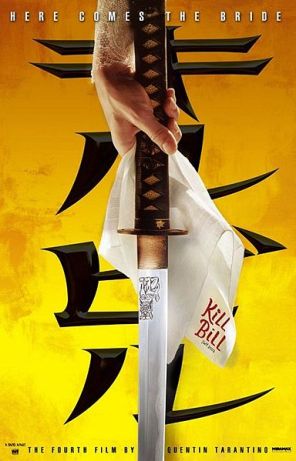


( http://www.imdb.com/title/tt0266697/ )

( http://www.imdb.com/title/tt0378194/ )


sexta-feira, 13 de abril de 2012

Jackie Brown (Edição de Coleccionador)


Info About The Movie:

Jackie Brown is a 1997 American crime drama film written and directed by Quentin Tarantino. It is an adaptation of the novel Rum Punch by American novelist Elmore Leonard and pays homage to 1970s blaxploitation films, particularly 1974's Foxy Brown.
The film stars Pam Grier (who also played Foxy Brown in the film of the same name), Robert Forster, Robert De Niro, Samuel L. Jackson, Bridget Fonda and Michael Keaton. It was Tarantino's third film following his successes with Reservoir Dogs (1992) and Pulp Fiction (1994).
Grier and Forster were both veteran actors but neither had performed a leading role in many years. Jackie Brown revitalized both actors' careers. The film garnered Forster an Academy Award nomination for Best Supporting Actor, and Jackson and Grier were nominated for Golden Globe Awards.

Plot

Jackie Brown (Pam Grier) is a flight attendant for a small Mexican airline, the latest step down for her career. To make ends meet, she smuggles money from Mexico into the United States for Ordell Robbie (Samuel L. Jackson), a gun runner under the close watch of the ATF.
Ordell learns that another of his workers, Beaumont Livingston (Chris Tucker), has been arrested. Fearing that Livingston will become an informant in order to avoid jail time, Ordell arranges for his bail with bondsman Max Cherry (Robert Forster). Following his release, Ordell promptly lures Livingston out to be killed.
Acting on information Livingston had indeed shared, ATF agent Ray Nicolette (Michael Keaton) and LAPD detective Mark Dargas (Michael Bowen) intercept Jackie as she arrives in the United States with Ordell's cash and some cocaine that Brown was unaware was stashed in her bag. Initially refusing to deal with Nicolette and Dargas, she is sent to jail on possession of drugs with intent to sell. Sensing that Jackie may now be just as likely to inform as Livingston had been, Ordell goes back to Max to arrange her bail. Max arrives to pick her up and, only partly masking his attraction to her, offers to buy her a drink and help determine her legal options.
Ordell later arrives at Jackie's house intending to murder her. She surprises him by pulling a gun she surreptitiously borrowed from Max's glove compartment, however, and barters a deal with Ordell whereby she will pretend to help the authorities while still managing to smuggle $500,000 of Ordell's money, enough to allow him to retire. To carry out this plan, Ordell employs Melanie Ralston (Bridget Fonda), a woman he lives with, and Louis Gara (Robert De Niro), a friend and former cellmate. He also uses a naïve Southern girl, Sheronda (Lisa Gay Hamilton).
With Jackie's help, Nicolette and Dargas arrange a sting to catch Ordell, unaware that Jackie and Ordell plan to double-cross them by diverting the actual money before the authorities make an arrest. Unbeknownst to the others, Jackie plans to deceive all of them with the help of Max in order to keep the $500,000 for herself.
After a trial run, during which Nicolette could observe the operation, the stage is set for the actual event. In a large shopping mall near Los Angeles, Jackie buys a new suit and enters a dressing room. Her role is to swap bags there with Melanie and Louis, supposedly passing off the $500,000 under Nicolette's nose. Instead, she gives Melanie only $50,000 and leaves the rest behind in the dressing room for Max to pick up. Jackie then feigns despair as she calls Nicolette and Dargas out from hiding and claims Melanie took all the money and ran.
In the parking lot, Melanie annoys and mocks Louis until he loses his temper and shoots her. Ordell discovers that Louis has only $40,000 in the bag (Melanie having kept $10,000 for herself after being tricked into doing so by Jackie). Ordell realizes Jackie has taken his money and, angered, kills Louis. Ordell's next concern is the involvement of Max Cherry, having been told by Louis that he spotted Max in the store before the pickup. Lured back to Max's office, where Jackie is said to be frightened and waiting to hand over his money, Ordell arrives armed. Jackie yells out that Ordell has a gun and he is shot dead by Nicolette, who had been hiding in another room.
In the clear with the law and in possession of the money, minus a 10% cut that Max has taken for himself, Jackie decides to leave the country and travel to Spain. Jackie invites Max to leave with her, but he declines before Jackie kisses him goodbye and leaves.

Extract Taken From: http://en.wikipedia.org/wiki/Jackie_Brown_(film)

Trailer From YouTube:


Pulp Fiction


Info About The Movie:

Pulp Fiction is a 1994 American crime film directed by Quentin Tarantino, who co-wrote its screenplay with Roger Avary. The film is known for its rich, eclectic dialogue, ironic mix of humor and violence, nonlinear storyline, and host of cinematic allusions and pop culture references. The film was nominated for seven Oscars, including Best Picture; Tarantino and Avary won for Best Original Screenplay. It was also awarded the Palme d'Or at the 1994 Cannes Film Festival. A major critical and commercial success, it revitalized the career of its leading man, John Travolta, who received an Academy Award nomination, as did costars Samuel L. Jackson and Uma Thurman.
Directed in a highly stylized manner, Pulp Fiction joins the intersecting storylines of Los Angeles mobsters, fringe players, small-time criminals, and a mysterious briefcase. Considerable screen time is devoted to conversations and monologues that reveal the characters' senses of humor and perspectives on life. The film's title refers to the pulp magazines and hardboiled crime novels popular during the mid-20th century, known for their graphic violence and punchy dialogue. Pulp Fiction is self-referential from its opening moments, beginning with a title card that gives two dictionary definitions of "pulp". The plot, as in many of Tarantino's other works, is presented out of chronological sequence.
The picture's self-reflexivity, unconventional structure, and extensive use of homage and pastiche have led critics to describe it as a prime example of postmodern film. Considered by some critics a black comedy,[2] the film is also frequently labeled a "neo-noir".[3] Critic Geoffrey O'Brien argues otherwise: "The old-time noir passions, the brooding melancholy and operatic death scenes, would be altogether out of place in the crisp and brightly lit wonderland that Tarantino conjures up. [It is] neither neo-noir nor a parody of noir".[4] Similarly, Nicholas Christopher calls it "more gangland camp than neo-noir",[5] and Foster Hirsch suggests that its "trippy fantasy landscape" characterizes it more definitively than any genre label.[6] Pulp Fiction is viewed as the inspiration for many later movies that adopted various elements of its style. The nature of its development, marketing, and distribution and its consequent profitability had a sweeping effect on the field of independent cinema (although it is not an independent film itself). Considered a cultural watershed, Pulp Fiction's influence has been felt in several other media.

Narrative structure

In keeping with writer-director Quentin Tarantino's trademark of nonlinear storytelling, the narrative is presented out of sequence. Pulp Fiction is structured around three distinct but interrelated storylines—in Tarantino's conception, mob hitman Vincent Vega is the lead of the first story, prizefighter Butch Coolidge is the lead of the second, and Vincent's fellow contract killer, Jules Winnfield, is the lead of the third.[7] Although each storyline focuses on a different series of incidents, they connect and intersect in various ways. The film starts out with a diner hold-up staged by "Pumpkin" and "Honey Bunny", then picks up the stories of Vincent, Jules, Butch, and several other important characters, including mob kingpin Marsellus Wallace, his wife, Mia, and underworld problem-solver Winston Wolf. It finally returns to where it began, in the diner: Vincent and Jules, who have stopped in for a bite, find themselves embroiled in the hold-up. There are a total of seven narrative sequences—the three primary storylines are preceded by identifying intertitles on a black screen:
  1. Prologue—The Diner (i)
  2. Prelude to "Vincent Vega and Marsellus Wallace's Wife"
  3. "Vincent Vega and Marsellus Wallace's Wife"
  4. Prelude to "The Gold Watch" (a—flashback, b—present)
  5. "The Gold Watch"
  6. "The Bonnie Situation"
  7. Epilogue—The Diner (ii)
If the seven sequences were ordered chronologically, they would run: 4a, 2, 6, 1, 7, 3, 4b, 5. Sequences 1 and 7 partially overlap and are presented from different points of view; the same is true of sequences 2 and 6. In Philip Parker's description, the structural form is "an episodic narrative with circular events adding a beginning and end and allowing references to elements of each separate episode to be made throughout the narrative."[8] Other analysts describe the structure simply as a "circular narrative".[9]

Plot

Prologue

"Pumpkin" (Tim Roth) and "Honey Bunny" (Amanda Plummer) are having breakfast in a diner. They decide to rob it after realizing they could make money off the customers as well as the business, as they did during their previous heist. Moments after they initiate the hold-up, the scene breaks off and the title credits roll.

Prelude to "Vincent Vega and Marsellus Wallace's Wife"
As Jules Winnfield (Samuel L. Jackson) drives, Vincent Vega (John Travolta) talks about his experiences in Europe, from where he has just returned: the hash bars in Amsterdam, the French McDonald's and its "Royale with Cheese". The pair—both wearing dress suits—are on their way to retrieve a briefcase from Brett (Frank Whaley), who has transgressed against their boss, gangster Marsellus Wallace. Jules tells Vincent that Marsellus had someone thrown off a fourth-floor balcony for giving his wife a foot massage. Vincent says that Marsellus has asked him to escort his wife while Marsellus is out of town. They conclude their banter and "get into character", which soon involves executing Brett in dramatic fashion after Jules recites a baleful "biblical" pronouncement.

Vincent Vega and Marsellus Wallace's Wife

In a virtually empty cocktail lounge, aging prizefighter Butch Coolidge (Bruce Willis) accepts a large sum of money from Marsellus (Ving Rhames), agreeing to take a dive in his upcoming match. Vincent and Jules—now dressed in T-shirts and shorts—arrive to deliver the briefcase, and Butch and Vincent briefly cross paths. The next day, Vincent drops by the house of Lance (Eric Stoltz) and Jody (Rosanna Arquette) to purchase high-grade heroin. He shoots up before driving over to meet Mrs. Mia Wallace (Uma Thurman) and take her out. They head to Jack Rabbit Slim's, a 1950s-themed restaurant staffed by lookalikes of the decade's pop icons. Mia recounts her experience acting in a failed television pilot, "Fox Force Five".
After participating in a twist contest, they return to the Wallace house with the trophy. While Vincent is in the bathroom, Mia finds his stash of heroin in his coat pocket. Mistaking it for cocaine, she snorts it and overdoses. Vincent rushes her to Lance's house for help. Together, they administer an adrenaline shot to Mia's heart, reviving her. Before parting ways, Mia and Vincent agree not to tell Marsellus of the incident.
Prelude to "The Gold Watch"
Television time for young Butch (Chandler Lindauer) is interrupted by the arrival of Vietnam veteran Captain Koons (Christopher Walken). Koons explains that he has brought a gold watch, passed down through generations of Coolidge men since World War I. Butch's father died of dysentery while in a POW camp, and at his dying request Koons hid the watch in his rectum for two years in order to deliver it to Butch. A bell rings, startling the adult Butch out of this reverie. He is in his boxing colors—it is time for the fight he has been paid to throw.

The Gold Watch

Butch flees the arena, having won the bout. Making his getaway by taxi, he learns from the death-obsessed driver, Esmarelda Villalobos (Angela Jones), that he killed the opposing fighter. Butch has double-crossed Marsellus, betting his payoff on himself at very favorable odds. The next morning, at the motel where he and his girlfriend, Fabienne (Maria de Medeiros), are lying low, Butch discovers that she has forgotten to pack the irreplaceable watch. He returns to his apartment to retrieve it, although Marsellus's men are almost certainly looking for him. Butch finds the watch quickly, but thinking he is alone, pauses for a snack. Only then does he notice a submachine gun on the kitchen counter. Hearing the toilet flush, Butch readies the gun in time to kill a startled Vincent Vega exiting the bathroom.
Butch drives away but while waiting at a traffic light, Marsellus walks by and recognizes him. Butch rams Marsellus with the car, then another automobile collides with his. After a foot chase the two men land in a pawnshop. The shopowner, Maynard (Duane Whitaker), captures them at gunpoint and ties them up in a half-basement area. Maynard is joined by Zed (Peter Greene); they take Marsellus to another room to rape him, leaving a silent masked figure referred to as "the gimp" to watch a tied-up Butch. Butch breaks loose and knocks out the gimp. He is about to flee when he decides to save Marsellus. As Zed is sodomizing Marsellus on a pommel horse, Butch kills Maynard with a katana. Marsellus retrieves Maynard's shotgun and shoots Zed in the groin. Marsellus informs Butch that they are even with respect to the botched fight fix, so long as he never tells anyone about the rape and departs Los Angeles forever. Butch agrees and returns to pick up Fabienne on Zed's chopper.

The Bonnie Situation

The story returns to Vincent and Jules at Brett's. After they execute him, another man (Alexis Arquette) bursts out of the bathroom and shoots wildly at them, missing every time before an astonished Jules and Vincent return fire. Jules decides this is a miracle and a sign from God for him to retire as a hitman. They drive off with one of Brett's associates, Marvin (Phil LaMarr), their informant. Vincent asks Marvin for his opinion about the "miracle", and accidentally shoots him in the face.
Forced to remove their bloodied car from the road, Jules calls upon the house of his friend Jimmie (Quentin Tarantino). Jimmie's wife, Bonnie, is due back from work soon and he is very anxious that she not encounter the scene. At Jules's request, Marsellus arranges for the help of Winston Wolf (Harvey Keitel). "The Wolf" takes charge of the situation, ordering Jules and Vincent to clean the car, hide the body in the trunk, dispose of their own bloody clothes, and change into T-shirts and shorts provided by Jimmie. They drive the car to a junkyard, from where Wolf and the owner's daughter, Raquel (Julia Sweeney), head off to breakfast and Jules and Vincent decide to do the same.
Epilogue
As Jules and Vincent eat breakfast in a coffee shop the discussion returns to Jules's decision to retire. In a brief cutaway, we see "Pumpkin" and "Honey Bunny" shortly before they initiate the hold-up from the movie's first scene. While Vincent is in the bathroom, the hold-up commences. "Pumpkin" demands all of the patrons' valuables, including Jules's mysterious case. Jules surprises "Pumpkin" (whom he calls "Ringo"), holding him at gunpoint. "Honey Bunny", hysterical, trains her gun on Jules. Vincent emerges from the restroom with his gun trained on her, creating a Mexican standoff. Reprising his pseudo-biblical passage, Jules expresses his ambivalence about his life of crime. As his first act of redemption, he allows the two robbers to take the cash they have stolen and leave, pondering how they were spared and leaving the briefcase to be returned to Marsellus, finishing the hitman's final job for his boss.

Extract Taken From: http://en.wikipedia.org/wiki/Pulp_Fiction

Trailer From YouTube: